Saturday, August 18, 2018

Understanding the Pareto Principle (The 80/20 Rule)

https://betterexplained.com/articles/understanding-the-pareto-principle-the-8020-rule/

Originally, the Pareto Principle referred to the observation that 80% of Italy’s wealth belonged to only 20% of the population.
More generally, the Pareto Principle is the observation (not law) that most things in life are not distributed evenly. It can mean all of the following things:
  • 20% of the input creates 80% of the result
  • 20% of the workers produce 80% of the result
  • 20% of the customers create 80% of the revenue
  • 20% of the bugs cause 80% of the crashes
  • 20% of the features cause 80% of the usage
  • And on and on…
But be careful when using this idea! First, there’s a common misconception that the numbers 20 and 80 must add to 100 — they don’t!
20% of the workers could create 10% of the result. Or 50%. Or 80%. Or 99%, or even 100%. Think about it — in a group of 100 workers, 20 could do all the work while the other 80 goof off. In that case, 20% of the workers did 100% of the work. Remember that the 80/20 rule is a rough guide about typical distributions.
Also recognize that the numbers don’t have to be “20%” and “80%” exactly. The key point is that most things in life (effort, reward, output) are not distributed evenly – some contribute more than others.


Life Isn’t Fair

What does it mean when we say “things aren’t distributed evenly”? The key point is that each unit of work (or time) doesn’t contribute the same amount.
In a perfect world, every employee would contribute the same amount, every bug would be equally important, every feature would be equally loved by users. Planning would be so easy.
But that isn’t always the case:
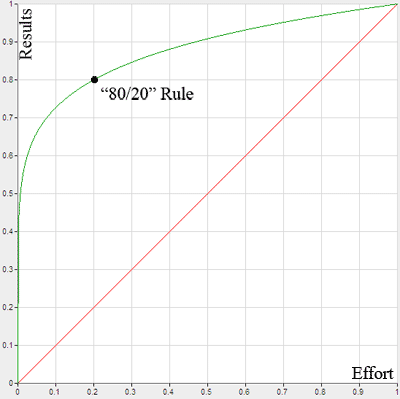
pareto principle graph
The 80/20 rule observes that most things have an unequal distribution. Out of 5 things, perhaps 1 will be “cool”. That cool thing/idea/person will result in majority of the impact of the group (the green line). We’d like life to be like the red line, where every piece contributes equally, but that doesn’t always happen.
Of course, this ratio can change. It could be 80/20, 90/10, or 90/20 (remember, the numbers don’t have to add to 100!).
The key point is that most things are not 1/1, where each unit of “input” (effort, time, labor) contributes exactly the same amount of output.

So Why Is This Useful?

The Pareto Principle helps you realize that the majority of results come from a minority of inputs. Knowing this, if…
20% of workers contribute 80% of results: Focus on rewarding these employees.
20% of bugs contribute 80% of crashes: Focus on fixing these bugs first.
20% of customers contribute 80% of revenue: Focus on satisfying these customers.
The examples go on. The point is to realize that you can often focus your effort on the 20% that makes a difference, instead of the 80% that doesn’t add much.
In economics terms, there is diminishing marginal benefit. This is related to the law of diminishing returns: each additional hour of effort, each extra worker is adding less “oomph” to the final result. By the end, you are spending lots of time on the minor details.

A Fun, Non-Math Example, Please

Everything is nice and rosy in the abstract. I want to give you a real example. Take a look at this awesome video of an artist drawing a car in Microsoft Paint. It’s pretty phenomenal what can be accomplished with such a basic tool:


Now let’s deconstruct this video. It’s about 5 minutes long, so each minute is about 20% of the way to completion (of course the video is sped up, but we are only interested in relative times anyway). Take a look at how the car evolved over time:

pareto principle car example 11:06 (Level 1) – Wireframe
pareto principle car example 22:00 (Level 2) – Basic coloring
pareto principle car example 33:05 (Level 3) – Beginning details: rims, windshield
pareto principle car example 44:04 (Level 4) – Advanced details: shading, reflections
pareto principle car example 55:05 (Level 5) – Finishing touches: headlights, background
Now, let’s say the artist was creating potential designs for a client. Given 5 minutes of time, he could present:
  • A single car at top quality (Level 5)
  • A reasonably detailed car (Level 3) and a colorized wireframe (Level 2)
  • 5 cars at a wireframe level (5 Level 1s)
“But Level 5 is way better than Level 1!” someone will inevitably shout.
The point isn’t that Level 5 is better than Level 1 — it clearly is. The question is whether a single Level 5 is better than five Level 1s, or some other combination.
Let’s say your customer doesn’t know whether they want a car, a truck, or a boat, let alone the color. Spending the time to create a Level 5 drawing wouldn’t make sense — show some concepts, get a general direction, and then work out the details.
The point is to put in the amount of effort needed to get the most bang for your buck — it’s usually in the first 20% (or 10%, or 30% — the exact amount can vary). In the planning stage, it may be better to get 5 fast prototypes rather than 1 polished product.
In this example, after 1 minute (20% of the time) we have a great understanding of what the final outcome will be. Most of the “work” is done up front, in the sense of deciding the type of vehicle, body style, and perspective. The rest is “filling in details” like colors and shading.
This isn’t to say the details are easy — they’re not — but each detail does not add as much to the picture as the broad strokes in the beginning. The difference between #4 and #5 is not as great as #1 and #2, or better yet, a blank drawing and #1 (the time from 0:00 to 1:06). You really have to look to see the differences on the car between #4 and #5, while the contribution #1 makes is quite obvious.

Concluding Thoughts

This may not be the best strategy in every case. The point of the Pareto principle is to recognize that most things in life are not distributed evenly. Make decisions on allocating time, resources and effort based on this:
  • Instead of spending 1 hour drafting a paper/blog post you’re not sure is needed, spend 10 minutes thinking of ideas. Then spend 50 minutes writing about the best one.
  • Instead of agonizing 3 hours on a single design, make 6 layouts (30 minutes each) and pick your favorite.
  • Rather than spending 3 hours to read 3 articles in depth, spend 5 minutes glancing through 12 articles (1 hour) and then spend an hour each on the two best ones (2 hours).
These techniques may or may not make sense – the point is to realize you have the option to focus on the important 20%.
Lastly, don’t think the Pareto Principle means only do 80% of the work needed. It may be true that 80% of a bridge is built in the first 20% of the time, but you still need the rest of the bridge in order for it to work. It may be true that 80% of the Mona Lisa was painted in the first 20% of the time, but it wouldn’t be the masterpiece it is without all the details. The Pareto Principle is an observation, not a law of nature.
When you are seeking top quality, you need all 100%. When you are trying to optimize your bang for the buck, focusing on the critical 20% is a time-saver. See what activities generate the most results and give them your appropriate attention.

Monday, July 16, 2018

3 Ways To Improve You Empathy

https://gordontredgold.com/2016/08/02/3-ways-to-improve-you-empathy/


Empathy is, for me, the toughest part of Emotional Intelligence to try and improve.

Why do I find empathy so hard? Well as much as I want to put myself in the shoes of the other person, it is in fact very difficult to truly appreciate, for me a white man, what it is really like to be a woman, or a person of color, etc. I probably have very few experiences that can directly relate to being treated unfairly because of the color of my skin or because of my sex, so how can I truly empathize.
It is hard but here are three tips that you can use to try and improve your empathy. They will help, but you have really make the effort. Otherwise you will be stuck with your perspective and will struggle to see the situation through the eyes of another person. I actually prefer that expression, the common putting yourself in someone else’s shoes, because just putting another pair of shoes on can be easy, but to see things through their eyes requires a lot more, effort, patience, and perseverance.
Challenge Your Prejudices and Stereotypes
We all have prejudices and stereotypes, and these are all based on our experiences, and they are not necessarily a bad thing, but they do stop us from seeing things as others with different prejudices and stereotypes. So we need to challenge ours, and to recognize them and where they come from, the better we understand them, the more we will notice our stereotypes coming in as we try to see things as other see them. But we need to be open to their thoughts about people. Imagine having a boss that you really, really like, and someone is trying to explain why they re causing them stress. If we cannot let go of our stereotype, we will start to explain why they are wrong, or how things are different to how they see them. Now we are trying to put them in our shoes, which is not the goal of empathy in this situation.
Be An Active Listener
We need to listen to what people say, understand their body language, hear their words and feel their feelings, rather than just wait for our turn to speak. We should ask questions, to improve our understanding, but questions that seek further information, not ones that look to change their view or highlight different possibilities. We need to take in all of the information and process it as it is sent, not filter it through our experiences.
Be Vulnerable
I know that sometime I can be closed off emotionally, I try to suppress my own feelings of vulnerability, But when I do that, I also close myself off to understanding the feelings of others. The more I share, the more open I am about myself, the more I find I better understand the feelings of others. It also gives them the confidence to share more, and also possibly relate how they are feeling to the feelings that I had, which then helps me better understand.
Empathy is hard to master; it takes real effort and commitment.  The more we can improve the better the leader we can be.

Friday, June 22, 2018

5 Daily Habits That Will Boost Your Leadership in 2018

https://www.inc.com/gordon-tredgold/5-simple-habits-that-will-upgrade-your-leadership-in-2018.html
By Gordon Tredgold

Being a better leader doesn't have to be that hard


Being a better leader has so many benefits it helps drive better results, helps increase employee retention, and it reduces stress levels.  The more you lead, the less you will have to manage, and it's management that raises the stress levels, not only for your team but also for yourself.  Management is hard, some days it can feel like trying to push an elephant up a steep incline, and if you get it wrong, that elephant will roll right over you and end up back at the bottom of the hill and then you have to start all over again.

Here are five simple habits that you can look to adopt that will help you become a better leader:

Be Engaged

Around 70% of employees are either disengaged or actively disengaged, and this put a big strain on the leadership which has to motivate and cajole them to try and achieves the desired results.

Interestingly according to similar studies on management, the levels of engagement of leaders is at or around the exact same levels.

Coincidence? I don't think so. 

It's impossible to engage people when you're not engaged yourself, and if you're not engaged then why should they be.

Engagement is infectious if you start to show more interest, and more involvement this will have a positive knock-on effect on your teams. Engaged teams are much easier to motive, require less management and achieve higher productivity levels.

Be Nice

It's nice to be important, but it's important to be nice. That might be a bit of a cliche, but it doesn't stop it from being true. People like to do business with people who they know like and trust, and being nice to people helps increase your likability rating. 

I know we are all under strict time pressures, but you will get better results from being courteous than you will from being curt.

People remember how you treat them 

Take An Interest

Showing an interest in your staff shows that you respect and value them. Too many bosses take no interest or even worse show a disdain for their staff, but this just increases their disengagement.

When you ask questions, either personal or business related, it helps build the connections between you and your team, and it will increase their respect for you.  I suggested this to one boss I worked with, and he said he would like to but didn't know what to say or ask.

Just start with "How is it going?" or "What do you think?" and then just listen.

Be Yourself


People can spot a phony from a mile away, and it just creates a feeling of distrust and a lack of trust kills your ability to lead.  I'm a big fan of authentic leadership, but when we use labels like that, it makes it sounds more difficult to do than it should be. 

Just be true to yourself, don't try to put on airs and graces or pretend to be something your not.

Admit your mistakes


If you make a mistake then just admit it, apologize if necessary and then move on. Admitting your mistakes shows humility, and a willingness to be vulnerable and your teams will appreciate that.

It shows that you accountability for your mistakes and that will encourage them to do the same.

When you become a better leader, it will have positive benefits for both your company, your teams and also for you and by adopting these simple habits you will start to see improvements in your leadership immediately.

Here's why your attitude is more important than your intelligence

https://www.weforum.org/agenda/2017/08/heres-why-your-attitude-is-more-important-than-your-intelligence
Dr Travis Bradberry
A worker arrives at his office in the Canary Wharf business district in London, Britain February 26, 2014.      REUTERS/Eddie Keogh/File Photo                GLOBAL BUSINESS WEEK AHEAD PACKAGE Ð SEARCH ÒBUSINESS WEEK AHEAD 5 SEPTEMBERÓ FOR ALL IMAGES - RTX2O4AU
Psychologist Carol Dweck has found that your attitude is a better predictor of your success than your IQ
Image: REUTERS/Eddie Keogh

When it comes to success, it’s easy to think that people blessed with brains are inevitably going to leave the rest of us in the dust. But new research from Stanford University will change your mind (and your attitude).

Psychologist Carol Dweck has spent her entire career studying attitude and performance, and her latest study shows that your attitude is a better predictor of your success than your IQ.

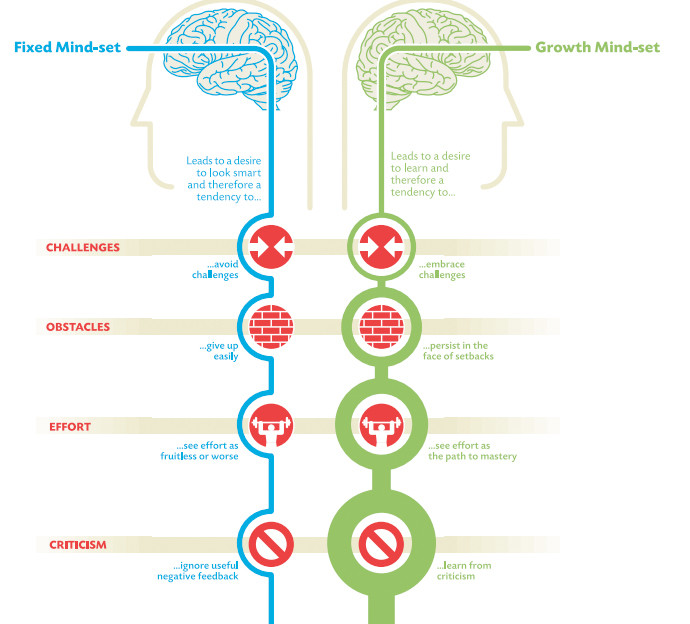
Dweck found that people’s core attitudes fall into one of two categories: a fixed mindset or a growth mindset.

With a fixed mindset, you believe you are who you are and you cannot change. This creates problems when you’re challenged because anything that appears to be more than you can handle is bound to make you feel hopeless and overwhelmed.

People with a growth mindset believe that they can improve with effort. They outperform those with a fixed mindset, even when they have a lower IQ, because they embrace challenges, treating them as opportunities to learn something new.

Image: LinkedIn

Common sense would suggest that having ability, like being smart, inspires confidence. It does, but only while the going is easy. The deciding factor in life is how you handle setbacks and challenges. People with a growth mindset welcome setbacks with open arms.

According to Dweck, success in life is all about how you deal with failure. She describes the approach to failure of people with the growth mindset this way,

Failure is information—we label it failure, but it’s more like, ‘This didn’t work, and I’m a problem solver, so I’ll try something else.’”

Regardless of which side of the chart you fall on, you can make changes and develop a growth mindset. What follows are some strategies that will fine-tune your mindset and help you make certain it’s as growth oriented as possible.

Don’t stay helpless. We all hit moments when we feel helpless. The test is how we react to that feeling. We can either learn from it and move forward or let it drag us down. There are countless successful people who would have never made it if they had succumbed to feelings of helplessness: Walt Disney was fired from the Kansas City Star because he “lacked imagination and had no good ideas,” Oprah Winfrey was fired from her job as a TV anchor in Baltimore for being “too emotionally invested in her stories,” Henry Ford had two failed car companies prior to succeeding with Ford, and Steven Spielberg was rejected by USC’s Cinematic Arts School multiple times. Imagine what would have happened if any of these people had a fixed mindset. They would have succumbed to the rejection and given up hope. People with a growth mindset don’t feel helpless because they know that in order to be successful, you need to be willing to fail hard and then bounce right back.

Be passionate. Empowered people pursue their passions relentlessly. There’s always going to be someone who’s more naturally talented than you are, but what you lack in talent, you can make up for in passion. Empowered people’s passion is what drives their unrelenting pursuit of excellence. Warren Buffet recommends finding your truest passions using, what he calls, the 5/25 technique: Write down the 25 things that you care about the most. Then, cross out the bottom 20. The remaining 5 are your true passions. Everything else is merely a distraction.

Take action. It’s not that people with a growth mindset are able to overcome their fears because they are braver than the rest of us; it’s just that they know fear and anxiety are paralyzing emotions and that the best way to overcome this paralysis is to take action. People with a growth mindset are empowered, and empowered people know that there’s no such thing as a truly perfect moment to move forward. So why wait for one? Taking action turns all your worry and concern about failure into positive, focused energy.

Then go the extra mile (or two). Empowered people give it their all, even on their worst days. They’re always pushing themselves to go the extra mile. One of Bruce Lee’s pupils ran three miles every day with him. One day, they were about to hit the three-mile mark when Bruce said, “Let’s do two more.” His pupil was tired and said, “I’ll die if I run two more.” Bruce’s response? “Then do it.” His pupil became so angry that he finished the full five miles. Exhausted and furious, he confronted Bruce about his comment, and Bruce explained it this way: “Quit and you might as well be dead. If you always put limits on what you can do, physical or anything else, it’ll spread over into the rest of your life. It’ll spread into your work, into your morality, into your entire being. There are no limits. There are plateaus, but you must not stay there; you must go beyond them. If it kills you, it kills you. A man must constantly exceed his level.”

If you aren’t getting a little bit better each day, then you’re most likely getting a little worse—and what kind of life is that?

Expect results. People with a growth mindset know that they’re going to fail from time to time, but they never let that keep them from expecting results. Expecting results keeps you motivated and feeds the cycle of empowerment. After all, if you don’t think you’re going to succeed, then why bother?

Be flexible. Everyone encounters unanticipated adversity. People with an empowered, growth-oriented mindset embrace adversity as a means for improvement, as opposed to something that holds them back. When an unexpected situation challenges an empowered person, they flex until they get results.

Don't complain when things don't go your way. Complaining is an obvious sign of a fixed mindset. A growth mindset looks for opportunity in everything, so there’s no room for complaints.

Bringing It All Together

By keeping track of how you respond to the little things, you can work every day to keep yourself on the right side of the chart above.

Sunday, March 25, 2018

Freed enterprise: Psychology beats business training when it comes to entrepreneurship

https://www.economist.com/news/business/21729454-among-small-business-owners-togo-least-psychology-beats-business-training-when-it-comes
Sep 21st 2017
Among small-business owners in Togo, at least


MANAGEMENT gurus have chewed over the topic endlessly: is a flair for entrepreneurship something that you are born with, or something that can be taught? In a break with those gurus’ traditions, a group of economists and researchers from the World Bank, the National University of Singapore and Leuphana University in Germany decided that rather than simply cook up a pet theory of their own, they would conduct a controlled experiment.

Moreover, instead of choosing subjects from the boardrooms of powerful corporations or among the latest crop of young entrepreneurs in Silicon Valley, Francisco Campos and his fellow researchers chose to monitor 1,500 people running small businesses in Togo in West Africa. These are not the sorts of business owners who give TED talks or negotiate billion-dollar mergers. The typical firm had three employees and profits of 94,512 CFA francs ($173) a month. Only about a third kept books, and less than one in 20 had a written budget.

Studying lots of small businesses instead of a few big ones allowed the academics to conduct a randomised controlled trial. Usually associated with medical research, these are considered one of the most convincing types of evidence. Participants (in this case firms) are assigned, at random, either to receive “treatment” (in this case, two different sorts of training) or to the control arm, which receives nothing. Recruit enough participants for good and bad luck to even out across the sample, and you can tell, with high confidence, which method—if any—is superior.

As they report in Science, the researchers split the businesses into three groups of 500. One group served as the control. Another received a conventional business training in subjects such as accounting and financial management, marketing and human resources. They were also given tips on how to formalise a business. The syllabus came from a course called Business Edge, developed by the International Finance Corporation.

The final group was given a course inspired by psychological research, designed to teach personal initiative—things like setting goals, dealing with feedback and persistence in the face of setbacks, all of which are thought to be useful traits in a business owner. The researchers then followed their subjects’ fortunes for the next two-and-a-half years (the experiment began in 2014).

An earlier, smaller trial in Uganda had suggested that the psychological training was likely to work well. It did: monthly sales rose by 17% compared with the control group, while profits were up by 30%. It also boosted innovation: recipients came up with more new products than the control group. That suggests that entrepreneurship, or at least some mental habits useful for it, can indeed be taught. More surprising was how poorly the conventional training performed: as far as the researchers could tell, it had no effect at all. Budding entrepreneurs might want to avoid the business shelves and make for the psychology section.

This article appeared in the Business section of the print edition under the headline "Mind over matter"

Wednesday, February 21, 2018

20 cognitive biases that screw up your decisions

http://www.businessinsider.sg/cognitive-biases-that-affect-decisions-2016-7/
Shana LebowitzSamantha LeeBusiness Insider US

You make thousands of rational decisions every day – or so you think. From what you’ll eat throughout the day to whether you should make a big career move, research suggests that there are a number of cognitive stumbling blocks that affect your behavior – and they can prevent you from acting in your own best interests.
Here we’ve rounded up the most common biases that screw up our decision-making:
Samantha Lee/Business Insider
Gus Lubin and Drake Baer contributed to this article.

What is a social entrepreneur ?

Home
http://www.schwabfound.org/content/what-social-entrepreneur

Social entrepreneurs drive social innovation and transformation in various fields including education, health, environment and enterprise development. They pursue poverty alleviation goals with entrepreneurial zeal, business methods and the courage to innovate and overcome traditional practices. A social entrepreneur, similar to a business entrepreneur, builds strong and sustainable organizations, which are either set up as not-for-profits or companies.
A social entrepreneur is a leader or pragmatic visionary who:
  • Achieves large scale, systemic and sustainable social change through a new invention, a different approach, a more rigorous application of known technologies or strategies, or a combination of these.
  • Focuses first and foremost on the social and/or ecological value creation and tries to optimize the financial value creation.
  • Innovates by finding a new product, a new service, or a new approach to a social problem. 
  • Continuously refines and adapts approach in response to feedback. 
  • Combines the characteristics represented by Richard Branson and Mother Teresa.
The Schwab Foundation employs the following criteria when looking for leading social entrepreneurs: Innovation, Sustainability, Reach and social impact.  
Social entrepreneurs share some come common traits including:
  • An unwavering belief in the innate capacity of all people to contribute meaningfully to economic and social development 
  • A driving passion to make that happen. 
  • A practical but innovative stance to a social problem, often using market principles and forces, coupled with dogged determination, that allows them to break away from constraints imposed by ideology or field of discipline, and pushes them to take risks that others wouldn't dare. 
  • A zeal to measure and monitor their impact. Entrepreneurs have high standards, particularly in relation to their own organization’s efforts and in response to the communities with which they engage. Data, both quantitative and qualitative, are their key tools, guiding continuous feedback and improvement. 
  • A healthy impatience. Social Entrepreneurs cannot sit back and wait for change to happen – they are the change drivers.
What is Social Entrepreneurship?
Social entrepreneurship is 
  • About applying practical, innovative and sustainable approaches to benefit society in general, with an emphasis on those who are marginalized and poor.
  • A term that captures a unique approach to economic and social problems, an approach that cuts across sectors and disciplines grounded in certain values and processes that are common to each social entrepreneur, independent of whether his/ her area of focus has been education, health, welfare reform, human rights, workers' rights, environment, economic development, agriculture, etc., or whether the organizations they set up are non-profit or for-profit entities.
  • It is this approach that sets the social entrepreneur apart from the rest of the crowd of well-meaning people and organizations who dedicate their lives to social improvement.

About organizational models
Leveraged non-profit ventures 
The entrepreneur sets up a non-profit organization to drive the adoption of an innovation that addresses a market or government failure. In doing so, the entrepreneur engages a cross section of society, including private and public organizations, to drive forward the innovation through a multiplier effect. Leveraged non-profit ventures continuously depend on outside philanthropic funding, but their longer term sustainability is often enhanced given that the partners have a vested interest in the continuation of the venture.
Hybrid non-profit ventures 
The entrepreneur sets up a non-profit organization but the model includes some degree of cost-recovery through the sale of goods and services to a cross section of institutions, public and private, as well as to target population groups. Often, the entrepreneur sets up several legal entities to accommodate the earning of an income and the charitable expenditures in an optimal structure. To be able to sustain the transformation activities in full and address the needs of clients, who are often poor or marginalized from society, the entrepreneur must mobilize other sources of funding from the public and/or philanthropic sectors. Such funds can be in the form of grants or loans, and even quasi-equity.
Social business ventures 
The entrepreneur sets up a for-profit entity or business to provide a social or ecological product or service. While profits are ideally generated, the main aim is not to maximize financial returns for shareholders but to grow the social venture and reach more people in need. Wealth accumulation is not a priority and profits are reinvested in the enterprise to fund expansion. The entrepreneur of a social business venture seeks investors who are interested in combining financial and social returns on their investments.